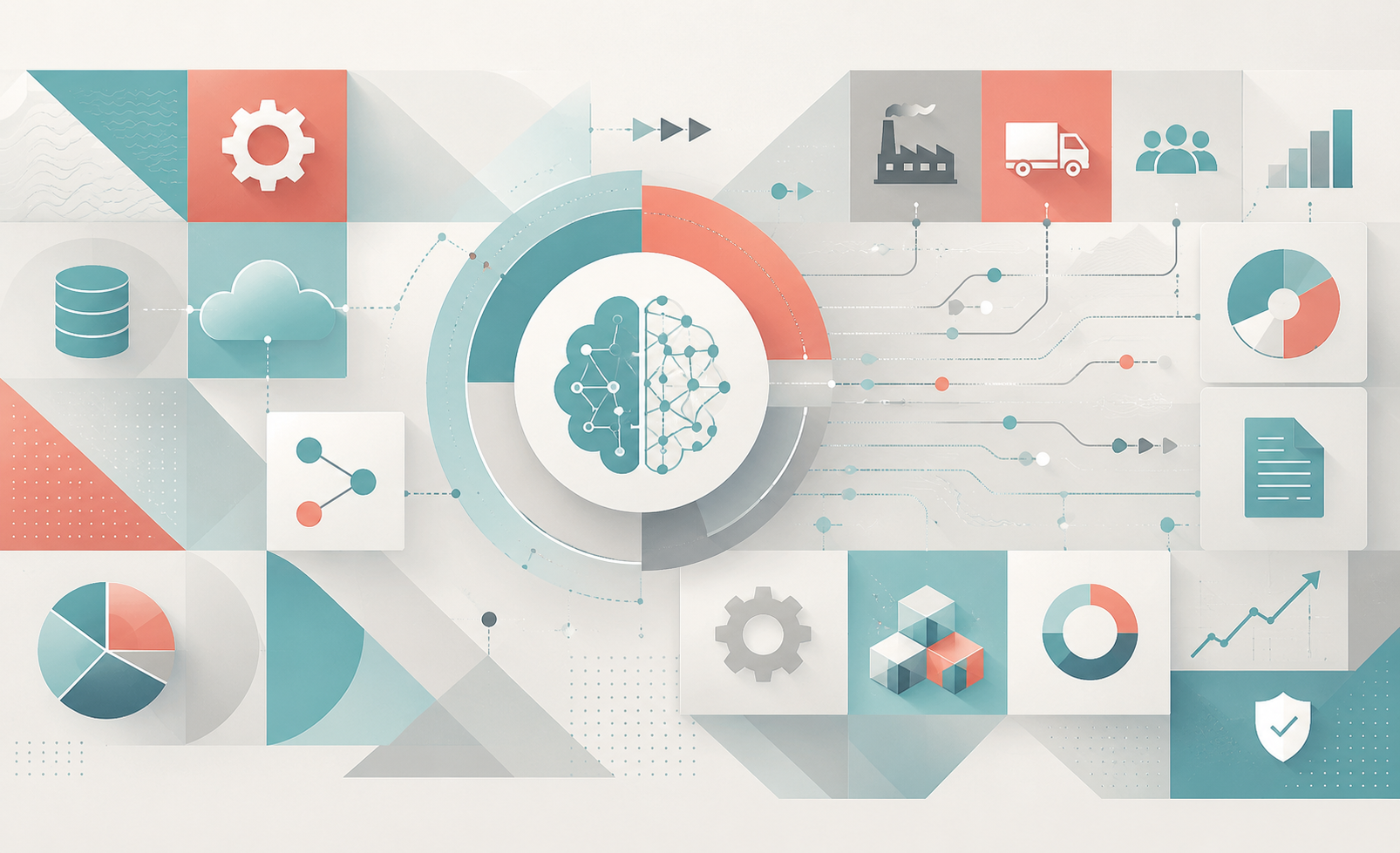
Artificial intelligence is rapidly changing how businesses manage information, automate processes, and make decisions. While AI was once considered a future technology, it is now becoming a practical business tool that organizations of all sizes can incorporate into their everyday workflows.
For businesses already using Claris FileMaker, AI opens up entirely new ways to interact with data. Instead of relying solely on traditional database searches or manual reporting, users can ask questions in natural language, retrieve information based on meaning rather than exact keywords, automate repetitive processes, and generate meaningful business insights in seconds.
Just as importantly, AI is no longer limited to experimental projects or enterprise software. With recent platform updates, AI capabilities are becoming a standard part of modern FileMaker development, allowing businesses to enhance existing applications without replacing the systems they already rely on.
In this guide, we explore what FileMaker AI is, why organizations are investing in it, where it delivers the greatest value, and the best practices for implementing AI successfully into your business.
What Is FileMaker AI?
FileMaker AI is a growing collection of AI capabilities that can be integrated into modern FileMaker applications.
Rather than being a separate product, AI enhances existing FileMaker solutions by making information easier to find, automating routine tasks, improving reporting, and enabling users to interact with business systems in everyday language.
Recent releases have significantly expanded these capabilities. FileMaker 2024 introduced native semantic search, AI script steps, and vector embeddings, while FileMaker 2025 built on that foundation with Retrieval-Augmented Generation (RAG), natural-language database queries, PDF text extraction, and more advanced AI workflows. Native AI functionality continues to expand with every new release, making AI an increasingly important part of the FileMaker platform.
At a high level, businesses can think of FileMaker AI as three complementary technologies working together.
If you’re looking for technical implementation guidance, be sure to read our article, The Future of FileMaker AI Integration: How to Integrate AI into FileMaker Applications.
Native AI features
Modern FileMaker includes built-in tools that simplify many common AI tasks.
These AI features include semantic search, vector embeddings, document understanding, prompt templates, and the ability to interact with multiple AI providers without requiring complex third-party integrations.
As the latest version of FileMaker evolves, more AI functionality is becoming available directly within the platform, reducing development complexity while giving organizations greater flexibility.
Read our article to discover how FileMaker’s native AI capabilities provide a low-barrier starting point for intelligent automation.
Natural language interaction
One of the most significant changes is the ability for users to communicate with business systems using plain English.
Instead of navigating multiple layouts or constructing complex searches, users can submit natural language queries and receive relevant information immediately.
Whether searching customer records, locating technical documentation, or retrieving project information, this approach makes FileMaker applications more accessible for everyday users.
Learn how to perform SQL Queries by Natural Language here.
Retrieval-Augmented Generation (RAG)
RAG is one of the most powerful additions to modern FileMaker development.
Rather than asking an AI model to answer from its general knowledge, RAG allows it to retrieve relevant business information before it will generate responses. This dramatically improves accuracy because answers are based on your own documents, knowledge base, and business records rather than public training data.
For organizations with extensive documentation, policies, or operational procedures, RAG creates intelligent assistants capable of delivering contextual answers using trusted internal information.
Read this helpful article to learn more about configuring your RAG account.
External AI services and LLM integrations
While FileMaker now includes many native AI capabilities, businesses can also connect to external large language models such as OpenAI, Anthropic, Cohere, or locally hosted AI environments.
These integrations allow organizations to build more advanced capabilities, including conversational assistants, document summarization, intelligent recommendations, classification engines, and workflow automation.
The key difference is that native FileMaker AI provides built-in functionality within the platform, while external AI services expand what those applications can accomplish through secure integrations.
For many businesses, the best solution combines both approaches to deliver AI experiences that are accurate, scalable, and aligned with existing operational workflows.
Why Businesses Are Adding AI to FileMaker
Businesses are not adopting AI simply because it is new. They are investing in it because it helps people work faster, find information more easily, and make better decisions.
Most organizations already hold valuable operational knowledge inside FileMaker. Customer records, inventory, project information, service history, financial data, technical documentation, and internal procedures all exist within the system. The challenge is making that information easier to access and use.
AI addresses this challenge by helping users interact with business data more naturally while reducing the manual effort required to perform everyday tasks.
Some of the biggest benefits include:
- Faster information retrieval through semantic search and natural language requests
- Reduced manual work by helping automate tasks and eliminate repetitive processes
- Better decision-making through AI-generated summaries and business insights
- Improved customer service by providing faster access to relevant information
- Smarter reporting that transforms complex data into understandable summaries
- Better knowledge management across teams and departments
- Increased operational efficiency through workflow automation delivered by your AI account
Rather than replacing employees, AI enables teams to spend less time searching, sorting, or compiling information and more time acting on it.
Many organizations begin by introducing AI for relatively simple tasks, such as searching records or summarizing documents. As confidence grows, businesses expand AI into customer service, reporting, CRM workflows, forecasting, and operational decision support.
Because AI integrates directly into existing FileMaker applications, organizations can modernize their systems without rebuilding them from scratch. This allows businesses to continue leveraging the custom workflows they’ve already invested in while adding new intelligence where it delivers the greatest value.
Ultimately, AI should not be viewed as a standalone technology project. It is another step in improving operational efficiency, reducing administrative overhead, and helping people make more informed decisions using the data they already have.

Exciting New AI Features
Recent FileMaker releases have introduced powerful new AI capabilities that help businesses work more efficiently and get more value from their data. In FileMaker 2025, users can interact with applications using natural language queries, making it easier to retrieve information without complex searches.
New AI features also support AI-driven data summarization and sentiment detection, allowing businesses to quickly identify trends, understand customer feedback, and generate meaningful insights. Together, these capabilities streamline operations, enhance user interactions, and enable more informed, real-time decision-making within FileMaker Pro.
Key takeaways:
- Interact with FileMaker using natural language instead of complex searches.
- Generate AI-powered summaries to quickly understand reports, documents, and business data.
- Detect customer sentiment and identify trends faster.
- Improve user experiences with more intuitive AI-driven interactions.
- Support faster, real-time decision-making with intelligent insights.
- Streamline workflows by reducing manual analysis and repetitive tasks.
Industry Use Cases for FileMaker AI
One of FileMaker’s greatest strengths has always been its flexibility.
That flexibility becomes even more valuable when AI is introduced, allowing businesses to build intelligent workflows tailored to their industry rather than relying on generic software.
The FileMaker development process delivers proven solutions for:
Manufacturing
Manufacturers generate enormous volumes of operational information every day.
AI helps transform that information into practical business intelligence by improving reporting, searching documentation, and identifying trends across production data.
Examples include:
- Predictive inventory forecasting
- AI-assisted production reporting
- Semantic search across operating procedures and quality documentation
- Intelligent quality management systems
- Trend analysis for production performance
Businesses looking to modernize manufacturing operations can also explore our guide to FileMaker ERP Software vs Off-the-Shelf Solutions for Manufacturing, which explains how custom ERP solutions create a stronger foundation for AI-powered operations.
Professional services
Professional service firms often manage thousands of client interactions, proposals, projects, and financial records.
AI can assist by generating project summaries, improving CRM workflows, producing proposal drafts, and creating management reports using existing business information.
Rather than replacing professional expertise, AI reduces administrative effort while helping consultants and account managers respond faster to clients.
Learn more about FileMaker Inventory & Accounting Integration here.
Healthcare
Healthcare organizations manage large volumes of structured and unstructured information.
AI enables staff to retrieve information across patient records, treatment documentation, and internal knowledge bases far more efficiently than traditional keyword searches.
Semantic search, intelligent document retrieval, and knowledge management help clinicians and administrators locate relevant information quickly while improving operational efficiency.
Education
Educational institutions can use AI to simplify administrative workloads while improving access to information.
Examples include:
- Student information lookup
- AI assistants for staff
- Administrative reporting
- Knowledge assistants for HR and policy questions
To learn more about custom education platforms, read our guide to FileMaker Solutions for Education: Building Custom Student Management Systems.
You can also read about Streamlining Early Intervention with Custom Software.
Field service
Field service businesses depend on timely information and effective coordination between office staff and technicians.
AI can support technicians with intelligent knowledge assistants, searchable service histories, automated scheduling insights, and quicker access to maintenance documentation.
When combined with calendar and scheduling integrations, AI helps improve productivity and reduce delays across field operations.
Frequently Asked Questions
Does FileMaker have AI built in?
Yes. Modern versions of Claris FileMaker include native AI capabilities that continue to expand with each release. FileMaker 2024 introduced semantic search and AI FileMaker script steps, while FileMaker 2025 added Retrieval-Augmented Generation (RAG), natural language database queries, PDF text extraction, and enhanced support for AI-powered workflows.
Which FileMaker version supports AI?
AI functionality first became available in FileMaker 2024 and has been significantly expanded in FileMaker 2025 and later releases. The newest versions include more advanced tools for semantic search, document processing, prompt templates, AI chat experiences, and intelligent data retrieval.
Can FileMaker integrate with ChatGPT?
Yes. FileMaker can integrate with ChatGPT and other AI providers through native AI functionality or secure API connections.
Depending on your requirements, businesses can build conversational assistants, document summarization tools, customer service automation, reporting assistants, and intelligent business workflows.
What AI models work with FileMaker?
Modern FileMaker supports multiple AI providers, including OpenAI, Anthropic, Cohere, and compatible self-hosted models. This flexibility allows organisations to select the provider that best suits their privacy, performance, and business requirements.
Is FileMaker AI secure?
It can be.
Security depends on how AI is implemented and the models being used. Many organizations choose architectures that keep sensitive business information within their own environment or use enterprise AI services with appropriate security controls.
When designed correctly, AI can be integrated while maintaining strong governance, privacy, and compliance standards.
Can AI search FileMaker records?
Yes.
One of the biggest advantages of modern FileMaker AI is the ability to search information using meaning rather than exact keywords.
Instead of remembering specific record names or terminology, users can ask questions naturally and retrieve relevant FileMaker records using semantic search.
What is semantic search?
Semantic search uses artificial intelligence to understand the intent behind a search rather than matching exact words.
For example, someone searching for “late customer payments” could still find information containing “overdue invoices,” even if those exact words were never entered into the search.
This makes finding business information significantly faster and more intuitive.
What is RAG in FileMaker?
Retrieval-Augmented Generation (RAG) combines AI with your own business knowledge.
Rather than generating answers from general internet knowledge, the AI retrieves relevant information from your documents, databases, or knowledge base before creating a response.
This improves accuracy and helps reduce incorrect or fabricated responses, making it particularly valuable for organizations with large internal knowledge libraries.
Can AI improve FileMaker CRM?
Absolutely.
AI can enhance CRM systems by summarizing customer interactions, generating sales insights, recommending follow-up actions, improving knowledge retrieval, and assisting staff with faster responses.
These capabilities help teams spend less time searching for information and more time building customer relationships.
Do I need custom development?
That depends on your goals.
Simple AI functionality may be achievable using native FileMaker capabilities, but organizations with complex workflows, multiple business systems, custom business logic, or advanced security requirements typically benefit from experienced FileMaker developers.
A custom approach ensures AI aligns with your existing processes while remaining scalable as your business grows.
Build a Smarter Business with FileMaker AI
Artificial intelligence is changing the way organizations interact with business information, but its greatest value comes from solving real operational challenges.
Whether it’s helping staff find information faster, automating repetitive processes, improving reporting, or supporting better business decisions, AI enables organizations to get more value from the FileMaker solutions they already rely on.
The key is implementing AI with purpose.
By focusing on practical business outcomes, integrating AI into existing workflows, and building on a scalable foundation, organizations can introduce intelligent capabilities that continue delivering value long after implementation.
At Alchemy, we combine more than 25 years of FileMaker expertise with a deep understanding of business operations to deliver AI solutions tailored to the way you work. From intelligent search and workflow automation to advanced integrations and enterprise-scale deployments, we help organizations build smarter, more capable business applications that evolve alongside their needs.
If you’re ready to explore how AI can enhance your FileMaker applications, Alchemy is here to help.
Let’s build smarter, more capable systems together.
Contact us today to discuss how our custom FileMaker solutions and integration services can help you run your business systems and processes more efficiently and effectively.
FILEMAKER SYSTEM ASSESSMENT
What should your FileMaker system do next?
Get an experienced second opinion on what's working, what's creating friction, and which improvements are worth prioritizing.